



Photos of psoriasis at the initial stage of development can help you identify the disease.
It is very important to understand that the disease can manifest itself in different ways in different people: they differ in the degree of intensity, spread activity, location of the lesion and other factors.
The main task is to identify the symptoms and then immediately start treatment for early stage psoriasis.
Characteristics and symptoms of the initial stage.
If you know exactly what the initial stage of psoriasis looks like, you can literally start treating the disease right away.Symptoms of the initial stage have characteristic signs, which makes it possible to treat psoriasis at the initial stage even before visiting a doctor.
Yes, not all people have the opportunity to quickly visit a dermatologist at the initial stage of the disease.Therefore, treatment at home with simple means is relevant.These can be folk remedies and recipes, non-hormonal ointments or non-hormonal medications.
What does psoriasis look like in the early stages of its manifestation?Pay attention to the condition of your skin.
The main signs of psoriasis at an early stage of development are:
- Rashes on different parts of the body, bright in color and clear edges.Particularly susceptible to these types of rashes are areas of skin that have recently suffered a burn, cut, or hypothermia.Primary signs may appear 7 to 14 days after skin damage;
- Peeling of rashes.They form in the center of the plates;
- Itching.Psoriatic plaques and papules gradually begin to itch.But not everyone suffers from itchy psoriasis, so these symptoms are not universal.It occurs in approximately half of patients.
Initially, the papules in the initial stages, i.e. pimples, are very small.Its shape is hemispherical and the surface is smooth and shiny.After a few days, the rashes increase in size and clear scales form on top of them.
If you remove these scales of the disease and find three characteristic phenomena, you will be able to accurately determine that you have psoriasis at the initial stage.
- Stearic stains.The scales should be removed from the surface of the papules very easily, even if you literally touch them a little.
- Movie.The thermal film appears after removing limescale.The skin underneath is red, thin and moist.The surface of the scaleless papule is shiny.
- Dew.When you scrape the scales and remove them, drops of blood appear in their place.
Early stage symptoms usually last several weeks.During this period, it is extremely important to start effective treatment.If the disease is ignored, the papules can increase by 3 to 8 centimeters, merge into one whole and affect large areas of the skin.
Initial manifestations of psoriasis.
The initial stage of the disease is accompanied by localization in different parts of the body.It is almost impossible to predict where exactly psoriasis forms.But it is possible to identify precisely how psoriasis manifests in certain parts of the body during the initial stages of the disease.
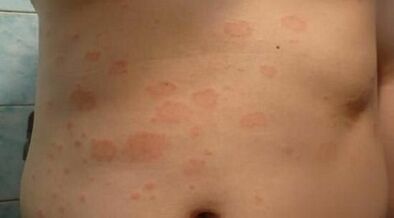
In most cases, they are mainly affected in the first stage:
- Elbows;
- Legs;
- Head;
- Nails;
- Hand;
- Face.
How exactly does psoriasis manifest on the body or other areas?
- Elbows.In the case of elbow psoriasis, photographs of the initial stage make it clear that here the person is mainly faced with the plaque form of the disease.The main symptom is small red rashes.Very quickly the rashes become covered with scales.The skin is characterized by greater roughness.
- Legs.As in the case of the elbows, small single rashes form on the legs, gradually increasing in number and size.Often the first papules are found in the foot or knee area.But in some cases the injuries affect other surfaces of the legs.
- Head.There are two options for damage: the skin or the scalp.The areas behind the ears and the back of the neck are the first to suffer.Papules that form on the head are often accompanied by unpleasant itching.The papules themselves are characterized by dampness and are covered with cracks.
- Nails.Photography makes it possible to clearly understand that nail psoriasis is in many ways similar to the manifestations of a fungus.First, longitudinal grooves are formed or some kind of indentations appear on the edges of the nails.The disease then spreads to the roots of the nails.Gradually, the nail plate becomes opaque and noticeably thick.As the disease progresses, the nails gradually peel and detach from the finger.This is not very pleasant, so it is recommended to immediately consult a doctor.He will prescribe the appropriate medication for external and internal use.
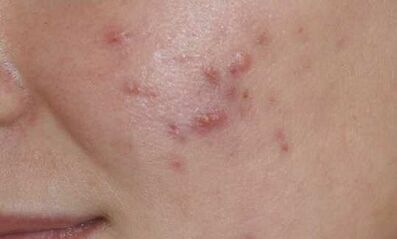
- Face.Fortunately for many people, especially women, facial psoriasis is a very rare form of the disease.But if you come across it, you can identify it by the formation of red papules on the eyelids, lips and nose, near the eyes and eyebrows.Psoriasis can also appear on the cheeks, forming a kind of fine mesh.Situations of psoriasis neoplasms on the lips, tongue and oral mucosa are extremely rare.
- Hands.If psoriasis affects the hands, the parts that bend (the fingers and elbows) are usually the first to be affected.Externally, psoriasis on the hands resembles sores.There are situations when papules form on the surface of the palms.In this course of the disease, psoriasis usually also affects the feet.
Treatment methods for psoriasis.
Having discovered the primary signs of the disease, you should immediately consult a doctor and start getting rid of the disease.The problem for many is that they start treatment late.And the treatment of psoriasis requires comprehensive treatment aimed at internal and external effects.
The essence of complex treatment is to use several techniques simultaneously:
- Pharmacological treatment.Its essence lies in taking medications.All of them are divided into hormonal and non-hormonal.In the initial stages, only non-hormonal medications are prescribed.Only if the situation worsens and psoriasis develops acutely, it is necessary to switch to hormonal drugs, antibiotics and other medications.
- External influence.Here we are talking about the use of ointments, creams and shampoos.Lotions, balms, all kinds of decoctions and baths prepared according to popular recipes are also used.Ointments are recognized as the most effective remedy in the fight against psoriasis.In this case, the ointments are both hormonal and non-hormonal.As is the case with medications, in the initial stages exclusively non-hormonal ointments are used.They are quite effective, but do not have several contraindications and side effects.
- Physiotherapy.The patient may be prescribed ultraviolet radiation, PUVA therapy, electrosleep, or other hospital procedures.Physiotherapy is treated most effectively in sanatoriums and resorts.
- Proper nutrition.It is very important to change your lifestyle if, due to the abuse of alcohol, junk food or cigarettes, an impulse arises for the manifestation of the disease.Very often, by eliminating harmful foods and getting rid of bad habits, a person's condition returns to normal and psoriasis does not bother him for a long time.This is a fact proven in practice.
In the primary stages of a disease such as psoriasis, it can be detected and treatment can begin.This is the most beneficial scenario for the patient, since a minimum of effort, time and money is required to suppress psoriasis.